Going Round in Circles: The British Roundabout as a Portal to National Madness
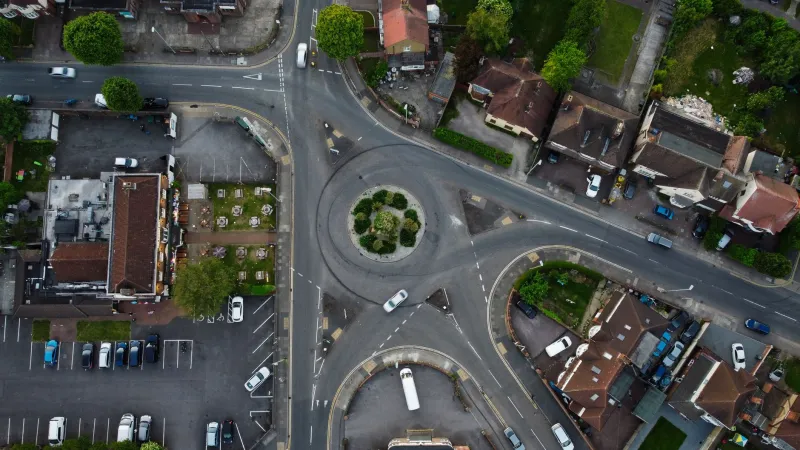
The Highway Code is, by the standards of government documents, a relatively readable publication. It is direct, it uses diagrams, and it largely avoids the kind of abstract managerial language that characterises most official British communication. On the subject of roundabouts, it is almost cheerfully clear: approach in the correct lane, give way to traffic from the right, signal when you're exiting.
And yet. Every day, on every roundabout in Britain, approximately none of this happens.
Instead, what happens is: a Toyota Yaris approaches in the left lane and then goes straight on. A BMW with no plates visible drifts across two lanes without indicating, conveying through body language alone that this is your fault. A van driver, who has been waiting to enter the roundabout for forty-five seconds, takes a gap that is technically not a gap and then makes sustained eye contact in his wing mirror to establish that he does not regret this. And somewhere in the queue, a man in a Volvo is gripping his steering wheel with both hands and mentally composing a letter to the local council that he will never send.
This is the British roundabout. It is an engineering solution that somehow became a national psychodrama.
A Brief, Proud History
Britain did not invent the roundabout — that honour belongs, depending on who you ask, to either the French or an American traffic engineer called William Phelps Eno — but Britain has, unquestionably, made it its own. There are approximately 25,000 roundabouts in the UK, which is more than any other country on earth. France, which also loves a roundabout with something approaching religious devotion, has more in absolute numbers but covers a much larger area. Britain, in other words, is dense with roundabouts. They are the connective tissue of the British road network, and, more importantly, the connective tissue of British social anxiety.
The modern give-way roundabout, as used throughout the UK, was developed in the 1960s by the Transport Research Laboratory and adopted nationally in 1966. Before this, roundabouts operated on a priority-to-entering-traffic rule, which caused gridlock so catastrophic it was essentially a metaphor for the entire post-war economy. The new system — give way to the right — was, by any measure, a significant improvement.
 Photo: Transport Research Laboratory, via image.slidesharecdn.com
What the Transport Research Laboratory did not model, presumably, was the psychological impact of placing British people in a situation where the rules are technically clear but socially ambiguous, and then asking them to negotiate it at 25mph with strangers.
The Indicating Question
There is no more reliably divisive act a British motorist can commit than indicating — or not indicating — on a roundabout. This is not hyperbole. People have strong feelings about this. Strong feelings. The kind of feelings that appear, at length, in the comments sections of local Facebook groups at 11pm on a Tuesday.
The Highway Code says: indicate right when approaching if you're taking any exit beyond the first, indicate left when you're about to exit. This is clear. This is sensible. This would, if universally followed, make roundabouts significantly less terrifying.
The actual practice of British motoring says: indicate if you feel like it, but be aware that whatever you do will be wrong. If you indicate left on entry, the driver waiting to join will assume you're turning off at the first exit and will pull out, causing you to brake sharply. If you indicate right and then fail to cancel it before your exit, the driver behind you will tailgate you for the next quarter mile as punishment. If you indicate nothing at all — which remains, incomprehensibly, the most common approach — you are operating on a principle of pure sovereign unpredictability, and everyone else on the roundabout must simply adapt to your chaos.
The indicating question is also, in some parts of Britain, a class issue. This will sound absurd. It is not absurd. In certain postcodes, indicating on a roundabout is considered faintly aggressive — an implication that other road users cannot be trusted to read the situation. In other postcodes, not indicating is considered aggressively inconsiderate — an implication that other road users don't matter. Both groups are furious with each other. Neither group is entirely wrong.
Milton Keynes: A Special Case
Milton Keynes was designed around roundabouts in the way that other cities are designed around rivers or trade routes. The grid road system that defines the city's layout uses roundabouts as its primary junctions, which means that driving in Milton Keynes is a continuous, meditative experience of give-way-to-the-right that either calms you completely or slowly dismantles your sense of self.
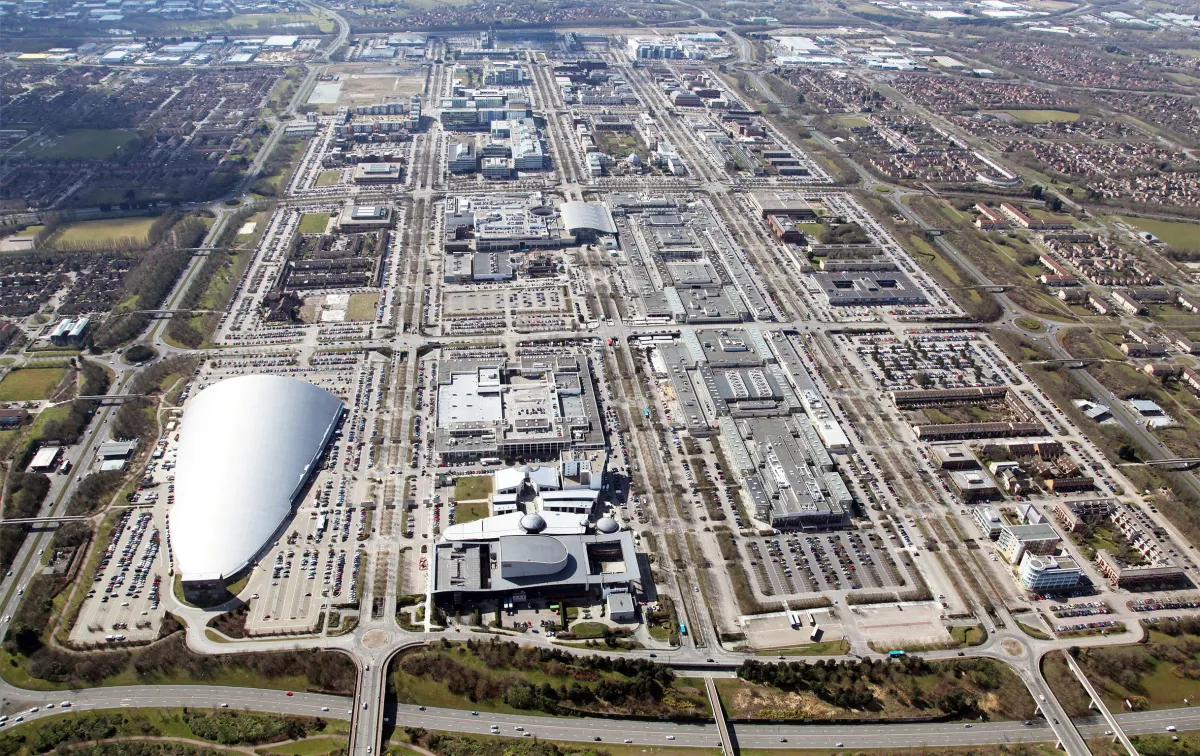 Photo: Milton Keynes, via static.independent.co.uk
For residents, this is simply Tuesday. For visitors — particularly those from cities where traffic lights are the dominant junction technology — Milton Keynes roundabouts represent a kind of freedom that quickly becomes overwhelming. There are no lights telling you when to go. There is only the roundabout, the oncoming traffic, and your own judgement. Many people find this empowering. Many more find it absolutely terrifying and begin indicating randomly just to feel in control of something.
Locals, it should be noted, are magnificent on Milton Keynes roundabouts. They flow through them with a fluid confidence that borders on arrogance. They are right to be confident. They are also, occasionally, insufferable about it.
The Magic Roundabout, Swindon
No discussion of the British roundabout is complete without paying due tribute to the Magic Roundabout in Swindon, which is not a metaphor but an actual piece of transport infrastructure so conceptually ambitious that it has become a minor tourist attraction.
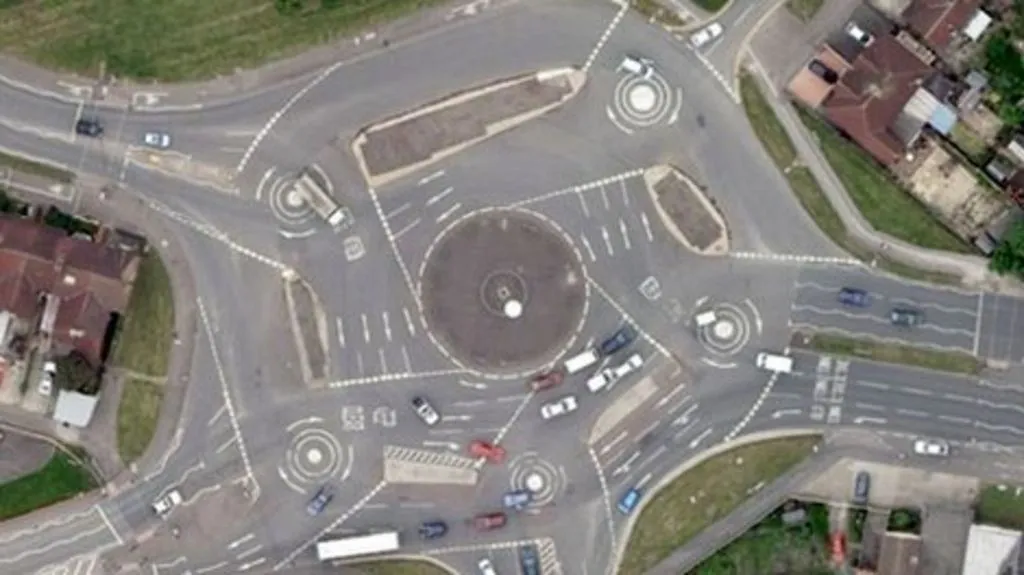 Photo: Magic Roundabout, Swindon, via ichef.bbci.co.uk
The Magic Roundabout — officially named the County Islands Roundabout, though nobody calls it that — consists of one large roundabout around which traffic travels clockwise, surrounded by five smaller roundabouts at each junction, around which traffic travels anticlockwise. It was built in 1972 and was, at the time, greeted with considerable local alarm. It has since been vindicated by traffic modelling, which suggests it moves vehicles through the junction with impressive efficiency.
It is also, to the uninitiated, completely incomprehensible. Visiting drivers frequently report a sensation of entering the roundabout with moderate confidence and exiting some time later on an entirely different road than intended, unsure of how they got there and unwilling to discuss it.
The Magic Roundabout is, in this sense, a perfect encapsulation of the British roundabout experience: technically rational, practically bewildering, and strangely fascinating once you've survived it.
The Etiquette Gap
What the roundabout exposes, more than any other junction type, is the gap between what Britain's rules say and what British people actually do — and the elaborate, unspoken social negotiation that fills that gap. The flashed headlights that mean 'after you' or 'I'm going, don't argue.' The half-wave of acknowledgement when someone lets you in, which you are obligated to return within approximately 0.8 seconds or be considered ungrateful. The slow creep into the junction that signals intent without fully committing, a manoeuvre of breathtaking passive-aggression.
None of this is in the Highway Code. All of it is understood.
The British roundabout, in the end, is less a piece of road infrastructure than a daily referendum on civic trust — a test of whether we can, as a society, negotiate shared space with minimal rules and maximum courtesy. Most of the time, just about, we manage it.
Sometimes, though, there's a BMW. And then all bets are off.