Nobody Knows What Synergy Means, But By God We're Going to Leverage It

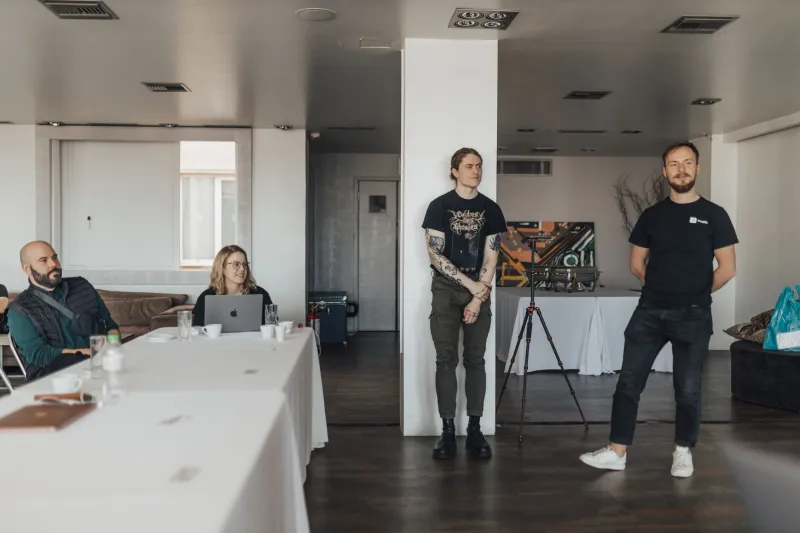
Photo by Photo by Yolanda Suen on Unsplash on Unsplash
Somewhere in a mid-sized office park on the outskirts of Coventry, a regional manager called Darren is preparing his quarterly strategy presentation. He has spent eleven hours on it. The slides are immaculate. The font is Calibri, because Darren respects tradition. And right there, on slide four, nestled between a stock image of people shaking hands over a glass table and a pie chart that doesn't quite add up to a hundred percent, sits the word that explains everything, justifies everything, and means absolutely nothing.
Synergy.
Darren doesn't know what it means. His director doesn't know what it means. The external consultant who first put it in a document in 2019 — and charged £8,400 for the privilege — almost certainly doesn't know what it means either. But it is there, and it is thriving, and questioning it would be tantamount to asking why the biscuits at the all-hands meeting are always Rich Tea.
You simply don't.
The Word That Ate British Business
Synergy, for those who have managed to avoid it, is defined in most dictionaries as something along the lines of "the interaction of elements that, combined, produce a total effect greater than the sum of their parts." This is a perfectly reasonable concept when applied to, say, chemistry, or the 1996 Manchester United midfield.
Applied to a merger between two struggling logistics firms in the East Midlands, it means something considerably less exciting: probably some redundancies, definitely a new logo, and almost certainly a six-month period during which nobody can find the stationery cupboard because it has been "consolidated."
And yet. The word has spread with the quiet, unstoppable efficiency of Japanese knotweed through a garden wall. It is in job descriptions for roles that didn't exist five years ago. It appears in the mission statements of organisations whose actual mission is to process insurance claims. It has been spotted in a council newsletter about recycling bin collection schedules, wedged between "community outcomes" and "holistic waste journey."
At some point, synergy stopped being a word and became a lifestyle.
The Hierarchy of Synergy Deployment
To understand how synergy functions in the modern British workplace, one must appreciate that it operates on several distinct levels, each more impenetrable than the last.
Level One: The Aspirational Mention. This is synergy deployed in an email subject line. "Re: Q3 — Exploring Synergies." Nobody replies. The email is filed. The synergies remain unexplored, like a particularly damp cave in Derbyshire.
Level Two: The Meeting Synergy. Here, a senior figure uses the word in a room full of people who write it down, underline it, and then stare at it for the remainder of the meeting hoping context will arrive. It doesn't. The meeting ends with an action point to "take a view on synergy alignment going forward."
Level Three: The Rebrand Synergy. This is the apex. Two organisations merge, a consultancy is hired, and the resulting press release contains the phrase "unlocking strategic synergies across our combined portfolio" at least three times. The new entity is given a name that sounds like a pharmaceutical product — Nexara, perhaps, or Verilix — and everyone gets new lanyards. Six months later, half the staff have left and the website still shows the old logo on the contact page.
Darren's Presentation: A Case Study
Back in Coventry, Darren is now on slide seven. He has used synergy four times. He is about to use it a fifth, in the phrase "cross-functional synergy enablement," which he composed himself at 11:40 on a Tuesday and has never spoken aloud.
His audience — seven colleagues, two of whom are on their phones and one of whom is definitely asleep — do not challenge him. This is the genius of synergy. It is critic-proof. To question it is to reveal yourself as someone who doesn't understand strategy, and nobody in a mid-sized office park on the outskirts of Coventry wants to be that person.
"We're really looking," Darren says, clicking to the next slide, "at how we can synergise our customer-facing touchpoints with our internal capability framework to drive genuine value creation."
The sleeping colleague stirs. Someone writes "synergise" on their notepad and draws a small arrow next to it, pointing at nothing.
The Consultant Industrial Complex
It would be unfair, of course, to lay this entirely at the feet of middle management. Synergy has a supply chain, and it runs directly through the consulting industry, which has been selling the concept — in various guises and at various price points — since at least the early nineties.
The formula is elegant in its simplicity. Identify an organisation experiencing the normal, mundane difficulties of organisational life: poor communication between departments, a software system that predates the iPhone, a staff survey that came back looking like a cry for help. Package these difficulties as a "synergy deficit." Propose a "synergy roadmap." Deliver a synergy roadmap consisting largely of workshops, a new Slack channel, and a values poster for the kitchen wall. Invoice accordingly.
Repeat until the organisation runs out of budget or patience, whichever comes first.
What Synergy Actually Means (Probably)
The most charitable interpretation of synergy's dominance is that it fills a genuine linguistic gap. English is wonderfully specific in many areas and frustratingly vague in others, and sometimes organisations do need a word for "the thing where two teams work together and it goes better than expected."
The less charitable interpretation — and the one that feels, if we're honest, more accurate — is that synergy is a comfort blanket for people who need to sound authoritative while saying very little. It is the corporate equivalent of nodding slowly and saying "absolutely" in a tone that suggests wisdom rather than confusion.
Darren finishes his presentation. There is a round of polite applause. His director says it was "really impactful" and suggests they "pick up on the synergy piece" in a follow-up session.
Darren writes this down. He is already thinking about slide one of the follow-up deck.
It will open with a quote about synergy. He found it on LinkedIn. It is attributed to someone called "Leadership Coach & Mindset Architect," which, now that you mention it, sounds like it might have some interesting synergies with Darren's own personal brand.
He underlines it twice.
Synergy.
The word glows on the screen. Somewhere, a consultant smiles.