SUSPICIOUS VAN ON SYCAMORE CLOSE — UPDATE 47: A Love Letter to the British Community Facebook Group

The post goes up at 11.43am.
'Has anyone else noticed the WHITE VAN that has been parked outside number 34 since this morning?? The driver just SAT THERE for 20 mins then left but the van is STILL THERE. Not one I recognise. Could be nothing but thought people should be AWARE. Stay safe everyone 🙏'
By noon, there are fourteen comments. By two o'clock, forty-seven. By the time the school run brings a fresh wave of participants to their phones, the thread has taken on the dimensions of a parliamentary inquiry, complete with conflicting eyewitness testimony, a request for more information from someone who 'works in security (can't say more)', and a lengthy digression about whether the council has started outsourcing its meter-reading to contractors.
The van, it will eventually emerge, belongs to a plumber named Gary who was fixing a boiler at number 34 and had nipped to Screwfix for a part. Gary is unaware that he has spent the afternoon as the subject of a neighbourhood threat assessment. Gary is just trying to sort out a boiler.
Welcome to the British community Facebook group, the single greatest theatre of disproportionate response that this nation has ever produced.
The Taxonomy of the Local Group
Every town, village, suburb, and postcode cluster in Britain now has at least one. Often several, which have formed through a process of ideological schism that would be recognisable to students of early Protestant Christianity.
There is the original group, founded around 2013, which has become ungovernable and now operates as a kind of digital town square crossed with a car boot sale crossed with a support group for people who have strong feelings about the new Lidl. Then there is the splinter group, formed when the original group's admin banned someone for posting a third consecutive photo of their cat. The splinter group has a stricter constitution. NO SELLING is non-negotiable. There is a pinned post about it.
Then there is the WhatsApp group, which is technically private but whose contents are routinely screenshot and posted to the Facebook group, creating an ouroboros of neighbourhood intelligence that would impress GCHQ.
The admins of these groups occupy a position somewhere between parish councillor and minor deity. They have the power to delete posts, issue warnings, and ultimately exile members — a sanction deployed with a seriousness that suggests they are not entirely clear on what exile means in this context, given that the exiled party continues to live on the same road.
The Incident Categories
The British community Facebook group has developed, over years of organic evolution, a remarkably consistent set of recurring incident types. Each one follows a recognisable dramatic arc.
The Suspicious Vehicle. Already documented above. The key features: the vehicle is almost always white, the original poster is almost always 'not saying it's anything, just flagging', and the resolution almost always involves a perfectly innocent explanation that approximately 40% of the thread refuses to accept. 'That's what they'd WANT you to think' is a common final position.
The Escaped Animal. A tortoise has been spotted near the Tesco Express. A 'large, possibly exotic' bird is in someone's garden. Someone's lurcher has got out again. These threads attract enormous warmth and a level of communal mobilisation that Britain's civil emergency infrastructure can only dream of. Within twenty minutes, seven people have offered to drive around looking. Someone has printed a flyer. The tortoise is invariably fine.
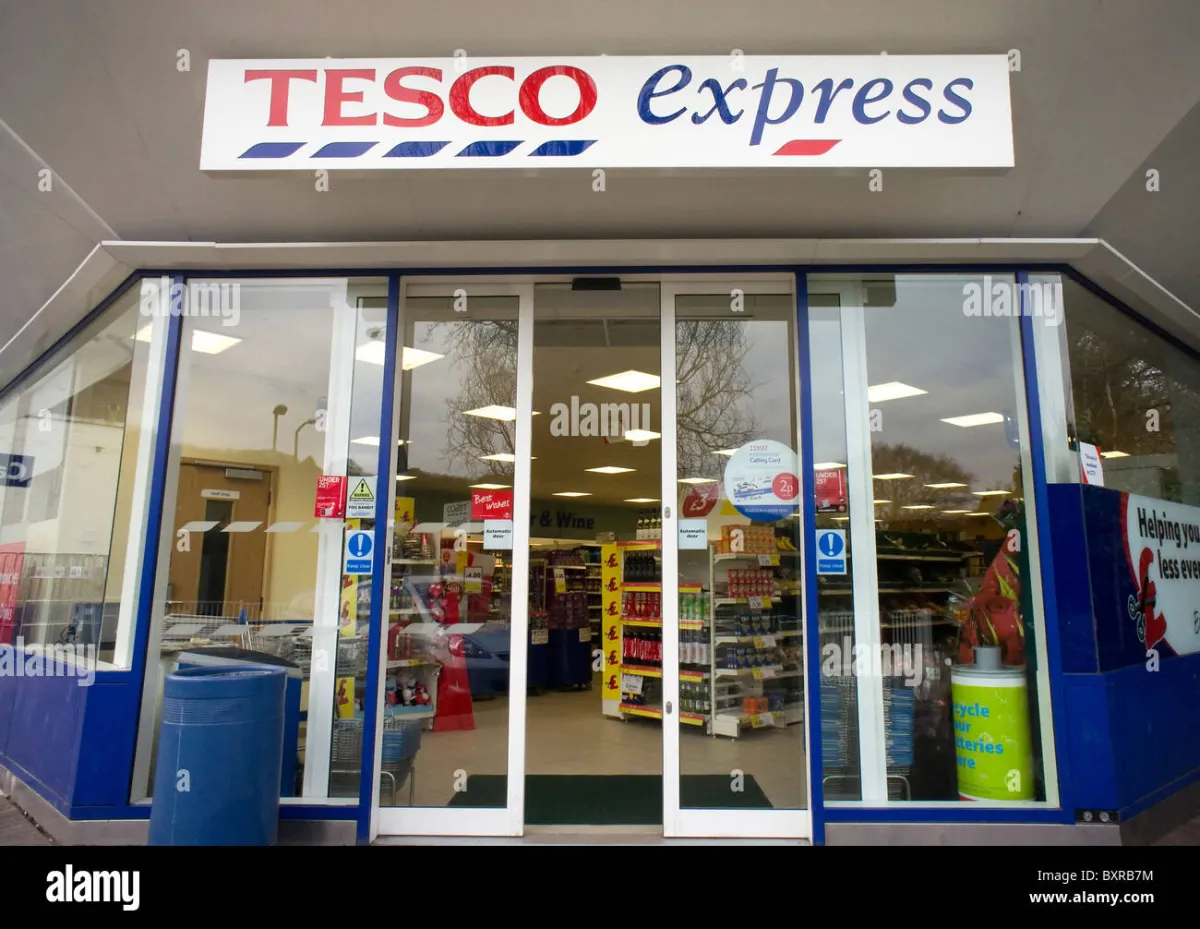 Photo: Tesco Express, via c8.alamy.com
The Noise Complaint. Usually a neighbour's music, a barking dog, or someone using power tools at what is described, with great precision, as 'gone eleven o'clock on a SUNDAY'. The thread divides cleanly into those who believe the poster should 'just knock and have a word' and those who believe the appropriate response is a formal complaint to the council, a call to the non-emergency police line, and a post in the group. These two factions have been arguing since 2019 and show no signs of resolution.
The Planning Application. This is where the group finds its deepest purpose. A planning application for a small rear extension, a dropped kerb, or — God help us all — a new development of twelve houses on the edge of the village, transforms the community Facebook group into something approaching the French Resistance. Petition links are shared. Meetings are called. Someone with a background in surveying, or who once watched a documentary about surveying, becomes briefly famous. The application is usually approved. The group posts a photo of the planning officer's car.
The Prose Style
It would be doing the British community Facebook group a disservice not to pause and appreciate its literary voice.
Capitalisation is deployed not for grammatical purposes but for emotional ones. Words that are capitalised include: VAN, CHILDREN, CLEARLY, AGAIN, DISGUSTING, HONESTLY, and the word SOMETHING when used to suggest vague menace. Exclamation marks travel in packs. The phrase 'just saying' is used to say things one wishes to say while technically disclaiming responsibility for saying them.
The emoji vocabulary is rich and specific. The 🙏 emoji signals both concern and a kind of benediction — I have flagged this, the matter is now in the hands of a higher power. The 😡 emoji is deployed early and liberally. The 🤔 emoji, appearing in response to an explanation, means 'I accept this information but reserve the right to remain suspicious'.
There is also a distinctive rhetorical move peculiar to these groups, which might be called the Concerned Disclaimer: 'Not wanting to cause alarm but...', followed by content specifically calibrated to cause alarm. This is the community Facebook group's version of 'with the greatest respect'.
In Defence of the Whole Magnificent Business
It would be easy — too easy — to mock all of this as small-minded parochialism, as people with too much time redirecting their anxieties onto Gary's Transit van.
But there is something else here, too. Something that, in a country that has spent thirty years watching its communal infrastructure quietly disappear — the pub, the post office, the church, the working men's club — is actually rather touching.
These groups are, for all their hysteria and their capital letters and their baffling sub-threads about whether the new speed bumps are the right height, a form of community. People in them know each other's names. They return lost dogs. They organise collections for neighbours who've had bad news. They share information about which local tradesperson is reliable and which one left a job half-finished and then stopped answering calls.
The van was Gary's. The tortoise was fine. The planning application went through. And Sycamore Close Residents & Friends (NO SELLING) carries on, watchful and slightly breathless, one white Transit away from a full community mobilisation.
Britain has never been more itself.