Tick the Box, Save the Planet: Inside Britain's Sustainability Bureaucracy Bonanza
Somewhere in a mid-sized British organisation — let's call it Midlands Partnership for Collaborative Futures, because that's what it's almost certainly called — a working group has convened. They have a mandate. They have a budget. They have, crucially, a 47-point sustainability self-assessment framework, printed on recycled paper, which has been laminated.
The irony of laminating recycled paper in the name of environmental responsibility has not been raised. It will not be raised. There is, after all, a form to complete.
The Birth of the Eco-Impact Assessment
It is difficult to pinpoint precisely when Britain decided that the most effective response to a planetary emergency was an online questionnaire, but here we are. Organisations across the country — councils, NHS trusts, housing associations, charities that exist primarily to produce strategy documents — have collectively embraced the sustainability checklist as both proof of conscience and substitute for action.
The checklist, in its natural habitat, is a magnificent creature. It typically opens with a section on 'organisational commitment,' which asks you to confirm that your organisation is committed to sustainability. You tick yes. You move on. Nobody checks. The planet, presumably, exhales with relief.
Section two usually concerns energy usage. Do you turn lights off? Do you have a policy about turning lights off? Do you have a policy about having a policy about turning lights off? Tick, tick, tick. By question fourteen, you are being asked whether your supply chain partners have completed their own sustainability assessments, at which point most reasonable people close the tab and go and make a cup of tea, which they will drink from a mug that has 'Every Day Is Earth Day' printed on it.
The Mandatory Training Module Cometh
No sustainability initiative is complete without the accompanying e-learning module. Thirty-five minutes. Unnarrated slides. A cartoon tree that waves at you when you answer correctly.
The module will cover: what carbon is (briefly), why carbon is bad (very briefly), and what you personally can do about carbon, which turns out to be: printing less, cycling to work if you live close enough, and separating your food waste. The module will not cover why your organisation's pension fund remains cheerfully invested in fossil fuel extraction, because that question does not have a cartoon tree.
Upon completion, you receive a certificate. The certificate can be downloaded and printed. Several people will print it, because they want something to show for their thirty-five minutes. The irony remains, as ever, unaddressed.
The Bin System: A Tragedy in Seven Colours
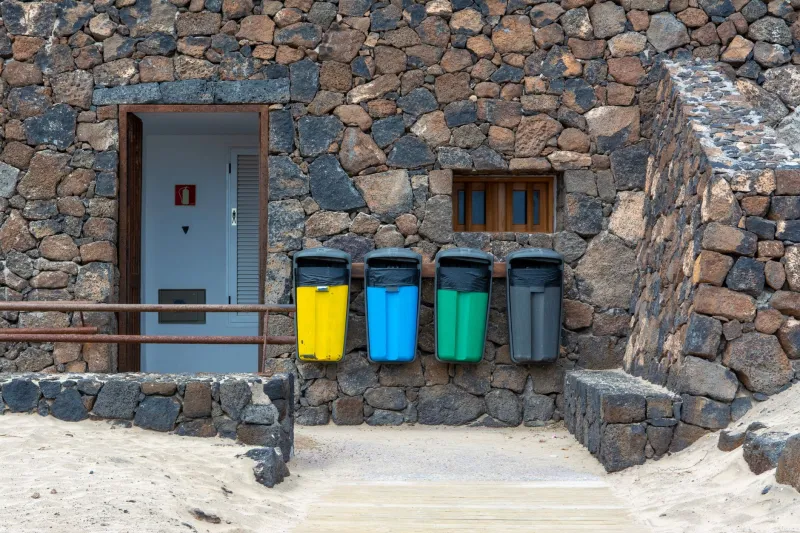
Perhaps no artefact better encapsulates Britain's sustainability theatre than the modern office waste station. Where once there was a single bin — democratic, unpretentious, effective — there now stands a cathedral of environmental intent: seven separate receptacles, colour-coded, labelled, and accompanied by a laminated guide that somehow makes the whole business more confusing than before.
Dark blue is for cardboard. Light blue is for paper. Green is for glass, but only certain glass. Yellow is for plastics one through five, but not six. Red is for batteries and small electricals. Black is for general waste. The seventh bin, which is brown, is for food waste, and it is always slightly sticky, and nobody goes near it.
Studies — well, observations by anyone who has ever worked in an open-plan office — suggest that approximately 73% of waste ends up in the black bin anyway, because the laminated guide has fallen behind the station and nobody can remember which blue is which. The bins are, in this sense, a perfect metaphor: elaborate, well-intentioned, and producing outcomes indistinguishable from what came before.
The Green Champion Programme
Every sufficiently large organisation now has a Green Champion. This is a member of staff — usually someone who made the mistake of mentioning they cycle to work — who has been given a lanyard, a quarterly newsletter to distribute, and approximately zero budget or authority to change anything structural.
The Green Champion will organise a litter pick. They will promote the litter pick via a poster featuring a hedgehog. Twelve people will sign up; four will actually attend. They will collect two bin bags of rubbish from a stretch of canal and feel briefly, genuinely good about it. The Green Champion will write this up as a success story for the sustainability report, where it will sit alongside the news that the office printer now defaults to double-sided, saving an estimated 340 sheets of A4 per annum.
Meanwhile, the organisation's physical estate — a collection of draughty 1970s buildings that consume energy with the enthusiasm of a child in a sweet shop — will be undergoing a feasibility study for potential future retrofitting, which is expected to conclude sometime before 2031.
The Sustainability Report Itself
Once a year, all of this activity is gathered, polished, and presented in the Annual Sustainability Report, a document of considerable length and considerable beauty. It features infographics. It features a message from the Chief Executive, who is photographed standing near a plant. It features a graph showing carbon emissions trending in the right direction, though the methodology note at the bottom — in eight-point font — explains that this year's figures exclude Scope 3 emissions, travel, procurement, and the new distribution centre in Northampton.
The report is printed in a run of 500 copies, full colour, on sustainably sourced paper, and distributed to stakeholders. Most copies go directly into — you guessed it — the black bin.
Progress, Defined Loosely
To be clear: nobody involved in any of this is malicious. The Green Champion genuinely cares. The person who designed the bin station genuinely hoped it would work. The e-learning module was commissioned by someone who believed, quite sincerely, that awareness leads to behaviour change.
But there is a particular kind of organisational self-deception at work in Britain's sustainability industrial complex — the comfortable conviction that measuring a problem, documenting a problem, and developing a framework for thinking about a problem is meaningfully different from doing nothing about a problem.
It isn't. It's just doing nothing with better stationery.
The 47-point form sits on the shared drive, completed, signed off, filed under 'Compliance — Environmental.' The cartoon tree waves. The laminated guide gathers dust beside the bins. And somewhere, a new working group is forming to scope out the feasibility of a net-zero roadmap consultation, which will report back in Q3, subject to resource availability.
The planet, we can only assume, is waiting for the outcome with bated breath.