Night Diggers: Confessions of a Nation That Cannot Stop Excavating Itself
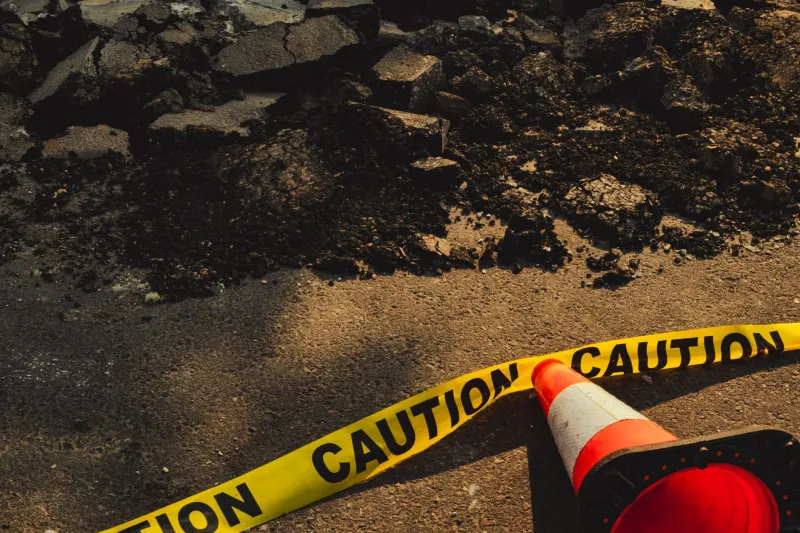
Every British town has a stretch of road that has been dug up so many times it no longer remembers what it looked like with tarmac. The cones appear overnight, the signs materialise from nowhere, and by morning the lane is gone — replaced by a hole, a generator, and three men in high-vis who regard passing motorists with the weary authority of people who know something you don't.
Welcome to Britain's most reliable public service: the roadwork that was never not there.
The Midnight Cone Deployment
It begins, always, at night. This is not an accident. Night is when Britain's road management apparatus feels most alive — when the fluorescent-jacketed operatives emerge, cones in hand, to claim their territory. By 11pm, a perfectly serviceable stretch of the A-something-or-other has been transformed into a single-lane chicane with a forty-eight-hour traffic light system and a 'road closed ahead' sign positioned at a point where it is no longer possible to turn around.
Where do the cones come from? Nobody knows. There is no visible lorry. There is no manifest. They simply appear, as though the road surface has been fermenting them in the dark, waiting for the right meteorological conditions to release them into the world. Britain has more traffic cones per capita than almost any country on earth — an estimated 1.25 million at any given time, according to figures that feel simultaneously too precise and entirely plausible. Many of these cones are guarding nothing. They are aspirational cones. Cones of intent.
The Sign That Raises More Questions Than It Answers
The temporary roadwork sign is a genre unto itself. Designed, apparently, by a committee that was given forty-five minutes and a clip-art library from 2003, these signs communicate urgency while somehow conveying the visual grammar of a man who has given up. The font wavers between authoritative and apologetic. The arrows point in directions that are technically accurate but spiritually misleading. And the message — 'ROAD WORKS FOR 8 WEEKS. WE APOLOGISE FOR ANY INCONVENIENCE' — is printed in a size that requires you to slow down to read it, which, in a roadwork zone, creates exactly the kind of tailback the sign is ostensibly trying to warn you about.
Some signs offer timelines. 'Works expected to complete: March 2024.' It is now September 2024. The sign has not been updated. The sign will not be updated. The sign has, in a very real sense, transcended its original purpose and become a permanent feature of the landscape — a monument to optimism, or possibly to the institutional difficulty of ordering a new sign.
Who Decides These Things?
This is the question that haunts every British motorist, cyclist, and pedestrian who has stood at a red light for seven minutes watching an empty contraflow. Who, exactly, is in charge of this?
The answer, it turns out, is: everyone and no one, in the finest British tradition. Highways England — now, confusingly, called National Highways, a rebrand that resolved nothing and cost quite a lot — handles the strategic road network. Local councils manage their own roads. Utility companies — gas, water, electricity, broadband — can apply for permits to dig up public roads and frequently do, sometimes in the same week, on the same stretch, without apparent coordination.
This is not a conspiracy. It is something more impressive than a conspiracy: it is a system. A system in which the right hand and the left hand are not merely unaware of each other's activities, but are operating under entirely different regulatory frameworks, reporting to different bodies, and possibly in different time zones.
BT digs up the road to lay fibre. Three weeks later, Thames Water digs it up again to fix a pipe that the fibre-laying disturbed. A fortnight after that, the council resurfaces it — badly, because the resurfacing budget was approved before the pipe was fixed and the specifications are now wrong — and within eighteen months, a pothole has formed at precisely the point where all three interventions met, like a geological record of institutional failure.
The Phantom Workforce
Perhaps the most enduring mystery of British roadworks is the workforce itself. The cones are there. The machinery is there — a digger, perhaps, or a drilling rig, occasionally a device whose purpose is entirely opaque. But the workers are frequently, magnificently, absent.
This is not idleness. To assume so is to misunderstand the nature of infrastructure work. Roadworks operate on a schedule that exists in a dimension slightly adjacent to ordinary time. Preparation phases, cable-routing phases, 'making good' phases — each requires the site to be secured, coned, lit, and signed, even when active work is not occurring. The cones, in this sense, are the work. They are holding space. They are doing something important that cannot be rushed.
The British public has, over generations, developed an intuitive understanding of this. You do not question the empty roadwork site. You do not approach the unattended digger. You queue, because queuing is what you do, and you listen to the radio, and you arrive eight minutes late, and you say nothing, because nothing useful has ever been said about roadworks that made them go faster.
The Road That Forgot It Was a Road
In Wolverhampton, there is — or was, depending on when you read this — a stretch of ring road that has been partially closed for so long that local businesses have adapted their signage to route customers around it. In Bristol, a set of temporary traffic lights installed during a water main repair in 2021 were still operational in late 2023, their permits quietly renewed, their purpose long since served, their removal apparently nobody's immediate priority.
These are not anomalies. They are the system working exactly as designed — which is to say, continuing, persisting, self-perpetuating, like a bureaucratic organism that has learned to survive in the wild.
Britain does not fix its roads. It manages them. It negotiates with them. It applies for permits to interfere with them, places cones around the interference, apologises for the inconvenience, and then, six months later, sends someone else to interfere with them again.
The road, to be fair, doesn't seem to mind. It has been here longer than the signs. It will be here long after the cones are gone.
Wherever they go.