Thirty-Four Miles Per Hour and the Meaning of Life: Dispatches from a Swindon Speed Awareness Course
I want to be clear from the outset that I was doing 34mph in a 30 zone. Not 50. Not on a motorway in fog. I was, on a Tuesday morning in October, travelling four miles per hour above the limit on a dual carriageway in Wiltshire that, for approximately 400 metres, drops to 30 before returning, with no apparent justification, to 40. A camera disagreed with my velocity. A letter arrived. And that is how I came to spend a Thursday afternoon in a conference suite in Swindon contemplating the nature of risk, personal responsibility, and whether the biscuits were going to appear before or after the laminated handouts.
The Venue
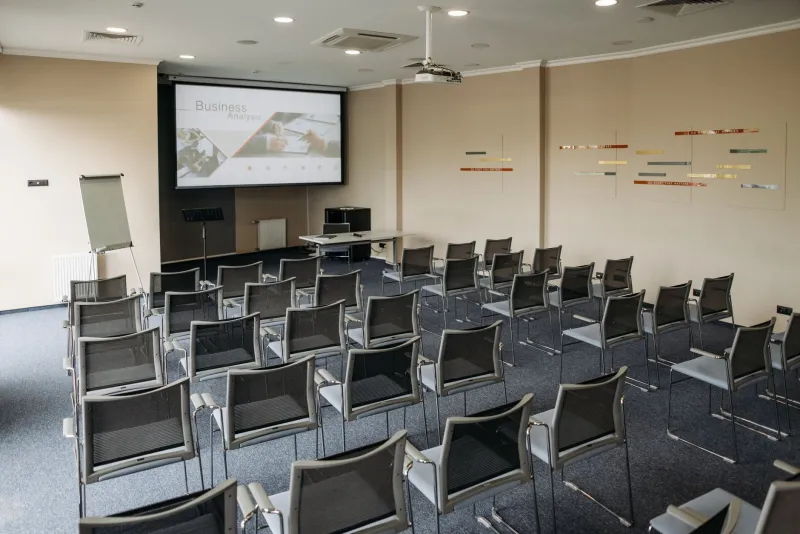
The National Speed Awareness Course is delivered, across Britain, in precisely the kind of room that seems designed to induce mild existential reflection. Ours was on the third floor of a business park hotel that smelled of carpet cleaner and buffet lunch. Twelve chairs were arranged in a shallow horseshoe. At the front stood a projector screen, a whiteboard, and our facilitator — a man I will call Graham, because he had the energy of a Graham — who greeted each arrival with the specific warmth of someone who has delivered this material four hundred times and has made a private peace with that fact.
The room contained a precise cross-section of mildly embarrassed Britain. There was a retired man in a fleece who clearly felt the whole thing was a tremendous imposition. There was a young woman who had driven 34mph in a 30 zone under what she described, to no one in particular, as 'genuinely unusual circumstances.' There was a man who introduced himself as a driving instructor, which created an atmosphere of low-level tension for the remainder of the session. And there was me, notebook open, which Graham clocked immediately and treated with the patient tolerance of a man who has seen stranger things.
The Cost of Reflection
Before we proceed, it is worth pausing on the economics of this arrangement, because they are instructive. The fixed penalty for a standard speeding offence — the notice you receive before being offered the course alternative — is £100, plus three points on your licence. The speed awareness course costs, depending on provider and region, between £87 and £100, with no points. The course, in other words, costs approximately the same as or slightly more than the fine it replaces, while additionally requiring you to give up four hours of your Thursday.
The Government does not profit from the courses — they are run by police and crime commissioners and delivered by contracted providers — but the providers most certainly do. The National Speed Awareness Scheme processes somewhere in the region of one million participants per year. At an average of £90 per head, this is, by any measure, a substantial industry built on the collective minor transgressions of otherwise law-abiding motorists. It is also, and this cannot be overstated, an industry built on the premise that what people who drove 34mph in a 30 zone primarily need is not a financial penalty but an opportunity to reflect.
The Pedagogy of Mild Guilt
Graham opened with ground rules. The course was, he explained, a 'non-judgmental space.' Nobody was here because they were a bad person. We were here because we had made a choice that, on reflection, we might make differently. This framing — the course as a gift of perspective rather than a consequence of being caught — was maintained with impressive consistency throughout the afternoon.
The material itself covered, in some depth, the physics of stopping distances, the relationship between speed and impact severity, and a number of statistics about road fatalities that were, it must be said, genuinely sobering. A car travelling at 40mph in a 30 zone does not arrive at an obstacle with 33% more force; the kinetic energy calculation means it arrives with considerably more. This is worth knowing. I did not know this. The retired man in the fleece did not know this either, and he had been driving for forty-three years.
For approximately ninety minutes, the course functioned as a legitimately useful piece of adult education. Then we entered the reflection phase.
The Reflection Phase
Britain's love of structured reflection is well-documented on these pages, and the speed awareness course represents one of its purer expressions. Graham distributed a worksheet — laminated, naturally — and invited us to consider the 'choices and circumstances' that had led to our being in this room. We were to write down what we had been thinking at the moment of the offence.
I wrote: 'I was listening to Radio 4 and thinking about whether I needed to stop for petrol.' The driving instructor wrote something lengthy that he declined to share. The young woman with the unusual circumstances wrote for quite a long time.
What followed was a group discussion of these reflections that bore, in both structure and emotional register, a striking resemblance to a CBT session. Graham used phrases like 'what might you do differently?' and 'how does that feel in retrospect?' He drew a diagram on the whiteboard involving a circle labelled 'control.' We discussed, at some length, the difference between hazards we can anticipate and hazards we cannot.
At no point did anyone suggest that a 400-metre stretch of 30mph limit on an otherwise 40mph dual carriageway might represent a hazard in its own right — a piece of road design so counterintuitive that it reliably generates camera income with the regularity of a toll booth. Graham, to his credit, handled this observation from the driving instructor with the diplomatic grace of a man who has heard it before.
The Biscuits
They arrived at the halfway break. Digestives, mostly, with a small number of chocolate Hobnobs that disappeared immediately. The coffee was the kind served in a cardboard cup that is too hot to hold but goes cold before you can drink it. We stood in the corridor discussing, with the awkward camaraderie of people who have shared a mildly embarrassing experience, our respective speeding incidents.
The retired man in the fleece had been doing 36 in a 30 on the way to a garden centre. The young woman's unusual circumstances, it emerged, involved a satnav that had not updated its speed limit data. The driving instructor had been caught on a road he believed, with some justification, had recently been reclassified. We were, in aggregate, a group of broadly reasonable people who had been, very briefly, slightly too fast.
What I Learned
I am not being entirely facetious when I say that I found the stopping distance material genuinely useful. I had not thought carefully about kinetic energy since a physics lesson I attended with considerable reluctance in 1997. The reminder that a small increase in speed produces a disproportionate increase in impact force is worth having.
But the therapeutic scaffolding around that information — the reflection worksheets, the non-judgmental space, the circle of control, the group processing of our vehicular choices — belongs to a tradition of institutional response that Britain has developed to remarkable sophistication: the tradition of treating every minor infringement as an opportunity for profound personal growth.
I drove home at a careful 29mph. Not because I had been transformed. But because there is a camera on the way out of the car park, and Graham mentioned it during the wrap-up, with a smile that suggested this was not the first time he had done so.
The tote bag, for the record, was not provided. That remains an outplacement industry exclusive.