Welcome Aboard! (Please Hold for the Next Available Values Seminar)

On your first morning, you will be given a tote bag.
This is not a metaphor. It is a physical tote bag, made of organic cotton, bearing the company's logo and one of its four core values — usually "Integrity" or "Bold," occasionally "Human," a word that has been doing a lot of heavy lifting in corporate communications since approximately 2018. Inside the tote bag you will find a branded water bottle, a notebook with the word "IDEAS" embossed on the cover, a lanyard, and a card welcoming you to "the family."
You are not joining a family. You are joining a mid-sized professional services firm in Milton Keynes. But for the next seventy-two hours, nobody is going to mention that.
 Photo: Milton Keynes, via www.printer-care.de
Day One: The Gathering
Modern British onboarding does not begin with work. It begins with other new starters — a cohort, in the language of the People Team, as though you are undergraduates rather than adults who have simply changed employers.
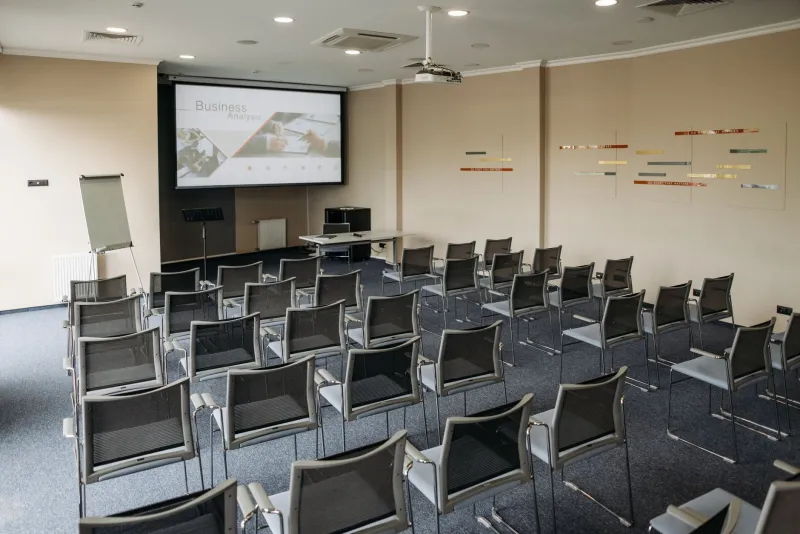
You will be gathered in a room that has been named something aspirational. The Horizon Suite. The Catalyst Hub. The Ignition Space. It will contain beanbags that nobody sits on, a wall of Post-it notes from a previous workshop that nobody has removed, and a screen showing a looping video of diverse, smiling employees doing things that your actual job will never require, such as standing on a rooftop or laughing at a whiteboard.
Your host for the day is someone whose job title is People Champion. Her name is almost certainly Jess. She has the professionally calibrated warmth of someone who has attended a two-day facilitation course and found it genuinely life-changing. She is delighted — delighted — that you're all here.
"Before we get started," Jess says, "let's do a quick icebreaker."
Something dies inside every person in the room simultaneously.
The Icebreaker: A Brief History of Suffering
The icebreaker exists to dissolve professional inhibition and create the conditions for authentic human connection. What it actually does is force thirty-seven strangers to reveal a fun fact about themselves under conditions of mild social coercion.
The fun facts follow a predictable distribution. Roughly forty per cent involve travel ("I've been to forty-two countries," delivered with the quiet confidence of someone who considers this a personality). Twenty per cent involve animals (a pet with an unusual name; a childhood encounter with livestock). Fifteen per cent are clearly fabricated. The remaining twenty-five per cent are a man called Graham saying he "likes football," which is not a fun fact but is at least honest.
You will say something. You will immediately forget what you said. You will spend the rest of the day mildly convinced that everyone found it strange.
The Slide Decks: An Annotated Tour
The content portion of onboarding is delivered via PowerPoint, which is fitting, because PowerPoint is the medium through which British corporate culture processes all information it considers important but does not wish to discuss.
The slide decks cover:
The Company's History. Founded in 1987, or 2003, or "reimagined" in 2019 following a merger that is described as "exciting" rather than "the result of a private equity restructure that resulted in 340 redundancies."
The Vision, Mission, and Values. The vision is to be the leading something-or-other in a particular space by a particular year. The mission is to deliver exceptional outcomes for clients, colleagues, and communities. The values are four words in circles that overlap in a Venn diagram suggesting they are all, somehow, the same thing.
The Organisational Structure. A chart of such complexity that it appears to have been generated by feeding the company's entire LinkedIn network into a diagram tool and pressing "expand all." You will not find your own name on it. You will not find your manager's name on it either, which will become relevant later.
Compliance, GDPR, and Information Security. Delivered by a man from IT who seems as surprised to be here as you are, and who will say the phrase "at the end of the day" forty-one times in forty minutes.
The Tour
On the afternoon of Day One, Jess leads a tour of the building. This is the portion of onboarding that will prove least useful, because the building you are touring is not the building you will work in. It is the head office — the mothership, the spiritual home — which is three hours away by train and which you will visit, at most, twice during your entire tenure.
The tour includes: the canteen ("we call it the Social Kitchen"), the wellness room (a cupboard containing a yoga mat and a diffuser), the innovation wall (a large magnetic board with no magnets on it), and the roof terrace (closed due to a risk assessment that has been ongoing since March 2022).
"Any questions?" asks Jess.
"Where do we keep the printer paper?" asks someone.
Jess smiles. "Great question. Your line manager will be able to help with the day-to-day logistics once you're settled in."
Days Two and Three: The Values Deep Dive
The second and third days of onboarding are given over to the company's values — not merely their definition, but their lived expression, which is a phrase that appears in the slide deck eleven times and means, as far as anyone can determine, that you should behave consistently with the words in the circles.
There are breakout sessions. There are scenarios. There is a moment where you are asked to identify which value you most personally embody, and you must choose between "Bold" and "Human" without laughing.
By Day Three, you have consumed fourteen cups of coffee from a machine that requires a four-digit code nobody can remember, attended six hours of facilitated discussion about organisational culture, and received three follow-up emails from Jess with subject lines like "Day Two Reflections — So Much Wonderful Energy!!"
You still do not know your login credentials. You do not know who to contact about expenses. You do not know the printer paper situation, which has become, in your mind, a symbol of everything.
The Promised Land
On Day Four, you arrive at your actual desk, in your actual office, to meet your actual team. Your manager is in back-to-back meetings until Thursday. Your laptop requires a software update that will take two hours. Someone has left a passive-aggressive note in the kitchen about the dishwasher.
It feels, unexpectedly, like home.
You still have the tote bag. You are using the water bottle. The notebook remains blank, awaiting ideas that the onboarding process was absolutely certain you would have.
The printer paper, it turns out, is in the stationery cupboard behind the fire door. Nobody told you this. You found it yourself, on your third day, by accident, during a walk that was technically a toilet break.
Some things, it seems, cannot be onboarded.