Destination: Nowhere — Inside Britain's High Street Resurrection Racket
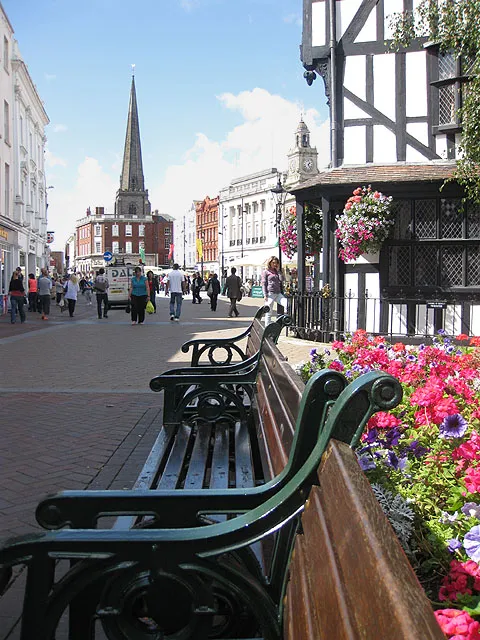
Photo: Pauline Eccles, CC BY-SA 2.0, via Wikimedia Commons
The sign went up on a Thursday. It was large, professionally printed, and depicted a cheerful geometric logo in teal and burnt orange — the colours that consultancies have collectively decided represent regeneration, creativity, and a bright future, regardless of whether the location in question has any particular claim to any of these things.
The sign read: Welcome to The Maltings Quarter — Where Heritage Meets Innovation.
Below the sign: a Greggs, a phone repair shop, three empty units with brown paper in the windows, and a former HSBC branch that has been empty since 2021 and now appears to contain one folding table and someone's abandoned filing cabinet.
The Maltings Quarter is, in this instance, a composite — a distillation of approximately forty-seven actual British town centres that have undergone what the regeneration industry refers to as a "destination transformation" and what the rest of us might call sticking a nice sign on a problem and hoping it wanders off.
Britain has an extraordinary number of these places now. They have names. They have logos. Several of them have their own Instagram accounts, maintained with declining frequency by a part-time digital engagement officer who is also responsible for the council's Twitter presence, the community newsletter, and booking speakers for the annual civic awards.
What they do not always have, in any great abundance, is people.
The Anatomy of a Destination
To qualify as a Destination, a struggling British town centre requires several things, none of which involve the sustained presence of economically viable retail.
First, a rebrand. The high street must be renamed. This is non-negotiable. "High Street" suggests the past, and the past is where the Woolworths used to be. The new name should evoke heritage (The Tannery, The Foundry, The Wharf, The Maltings — anything that implies industry without requiring any) while also hinting at a dynamic future. "Quarter" is a popular suffix, suggesting Parisian bohemia at a fraction of the cost and with considerably more rain.
Second, a mural. Ideally commissioned from a local artist, the mural should depict something that represents the town's identity: a historical figure, a native bird, an abstract representation of community. It will be painted on the side of a building that is otherwise scheduled for demolition in eighteen months, but this information is not included in the press release.
Third, a coffee offering. Not a café, note — a coffee offering. A kiosk, perhaps, or a converted horsebox, operated by someone called Reuben who roasts his own beans and can tell you the altitude of the farm where they were grown. Reuben's presence signals that the area is culturally alive. Reuben's lease is three months, with an option to extend, subject to footfall targets that nobody has formally defined.
Fourth, a heritage trail. Twelve laminated signs attached to lamp posts, each describing a building that no longer exists or has been converted into flats. Accompanied by a downloadable app that four hundred people downloaded in the first month and which has not been updated since.
Fifth, a press release. This is perhaps the most important element. The press release must contain the words "vibrant," "thriving," "reimagined," and "destination" at least twice each. It should quote the council leader, a local business owner (Reuben is always available), and if possible a minor celebrity with a tenuous local connection. It should not mention the vacancy rate, which is currently thirty-eight percent.
The Creative Quarter Gambit
For towns with a surplus of empty office blocks — and there are many, following the twin disruptions of remote working and the general migration of commercial activity to business parks that were built near a motorway junction in 1994 — the Creative Quarter offers a particularly elegant solution.
The principle is straightforward. Take a vacant office building. Subdivide it into small units. Offer peppercorn rents to artists, makers, and "creative entrepreneurs" (a category that encompasses everyone from jewellery designers to life coaches, united by the common characteristic of not yet generating enough income to pay market rent). Announce the Creative Quarter with considerable fanfare. Commission the mural. Hold an open day.
For a period of between six and eighteen months, the Creative Quarter is genuinely alive. Studios are occupied. There are events. A pop-up gallery opens on the second floor. Someone runs a pottery class on Wednesday evenings that fills up immediately and has a waiting list.
Then the economics reassert themselves. The peppercorn rents were always temporary. The building owner, having extracted the regeneration narrative and the associated planning goodwill, begins to think about conversion to residential. The jewellery designers scatter. The pottery class moves to a church hall. The pop-up gallery closes.
The building is now described in planning documents as having "an established creative heritage," which is apparently worth something in a planning application for forty-two one-bedroom flats.
The Footfall Fantasy
Every destination transformation comes with projections. Footfall will increase by thirty percent. Visitor spend will rise. The area will attract new businesses, new residents, new energy.
These projections are produced by consultancies, based on comparable case studies from other towns that were also projected to improve and also, in several cases, didn't. The projections are not legally binding. They are, in the technical sense, vibes.
The actual footfall data — when it is collected, which is not always, and when it is published, which is less often — tends to tell a more nuanced story. The mural attracted visitors for approximately three weeks, spiking on the day it was completed and again when a local newspaper photographed a pensioner standing in front of it. Reuben's coffee kiosk performed well in summer. Less well in November, when Reuben quietly folded his horsebox and pivoted to festivals.
The heritage trail app has thirty-seven active monthly users, sixteen of whom are council employees checking that it still works.
What Destinations Are For
It would be easy — and perhaps too easy — to conclude that destination transformations are simply a con. That they are a mechanism for councils to demonstrate activity without committing to the structural changes — business rates reform, public transport investment, affordable commercial premises — that might actually make a difference.
This is probably a little harsh. Some regeneration schemes do work, partially, for a while, in ways that are genuinely meaningful to the people involved. The mural is still a mural. The pottery class, wherever it ended up, is still running. Reuben learned a lot about himself.
But the destination delusion — the belief that renaming a place, commissioning a logo, and installing a coffee kiosk constitutes an economic strategy — has become so embedded in the vocabulary of local government that it is now almost impossible to challenge without sounding like you hate community, heritage, and artisan coffee simultaneously.
Which is a lot to have against you when you're standing in front of a teal and burnt orange sign, watching the brown paper in the empty windows shift slightly in the wind.
Welcome to The Maltings Quarter.
Where Heritage Meets Innovation.
Reuben will be back in spring.